|
|
|

|
FAQ 17 (Scro |
Heavy Resistance Training at Retirement?
Should you lighten up your lifting at retirement or keep going heavy?
A new study reported in the October 2024 issue of Harvard Health Letter says that training heavy at retirement induced lasting muscle strength.
The study enlisted 400 "well functioning" male and female individuals with an average age of 71, all of whom had recently retired, for one year of supervised resistance training with heavy loads. Their objective was to explore what happened after an additional three years.
Because skeletal muscle function declines with age, the researchers were observing the long term effects of heavy load training on preserved muscle mass and function. They found that such studies were sparse, and are important since the ageing population is growing and society is being challenged to promote "a healthy lifespan without age-related diseases and loss of autonomy." Loss of leg muscle strength can interfere with a person's mobility, and therefore their autonomy.
This is a study with a worthy goal right in line with the aims of this website.
Participants were assigned to one of three groups: heavy machine-based weight lifting three times a week for a year, moderate intensity strength training with resistance bands and bodyweight exercises, or a control group who were told to continue their normal activities.
Without going into a lot of the study details, the results showed that leg strength was still preserved at the same level for the heavy trainers after a subsequent three years, but fell off in the other two groups. The results, they concluded, provides practitioners and policy makers information "to encourage older individuals to engage in heavy resistance training."
The Harvard Health Letter encourages those interested in starting to train, or increasing the amount of weight they lift, to do it gradually, and consider working with a personal trainer for guidance.
For all the details, you can access the study on line. Here is the link: https://bmjopensem.bmj.com/content/bmjosem/10/2/e001899.full.pdf
My Take
Machines are safer than free weights for most people. With either free weights or machines, it is important to control the weight at all times. Don't jerk or attempt to throw the weight. Free weight squats, for instance, require more control than machines, and it's important to keep the back straight and stop when the thighs are parallel. Going further down makes it harder to avoid rounding the back.
You can move from squats to leg presses when you find it hard to keep your back straight. I do mainly bench squats and leg presses. As shown here leg presses free up the arms to help getting the weight up at the sticking point. You can use the arms to help on the last few reps when the going gets hard.
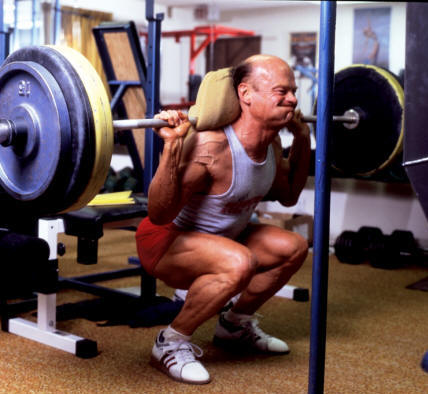
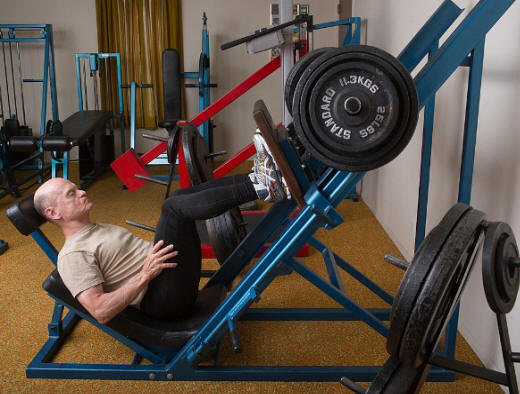
Photo by Pat Berrett Photo by Laszlo
Finally, if it hurts don't do it.
Long time trainers know all of this, but it doesn't hurt to hear it again.
Question from readers: What's the difference between osteoarthritis and rheumatoid arthritis?
In our article about aging feet (https://cbass.com/agingfeet.htm) we said that osteoarthritis in the feet is a condition that may have to be dealt with as we age. Some readers asked how to determine whether they had osteoarthritis or rheumatoid arthritis. What's the difference?
While both conditions may produce pain and stiffness, a person is more likely to have osteoarthritis than rheumatoid arthritis: about 30 million people eventually develop osteoarthritis, while only 1.5 million develop rheumatoid arthritis.
The key difference is causation.
Osteoarthritis is the gradual breakdown of the cartilage that surrounds joints eventually causing bone on bone rubbing and pain. Symptoms may not appear until older age (65 or so) on joints which have experienced overuse, repetitive use, or previous injury: hands, feet, wrists. Only one side of the body may be affected. X-rays show the deterioration and are a diagnostic tool. Harvard Health adds that there may be a genetic risk factor which could contribute to cartilage deterioration.
Rheumatoid arthritis, in contrast, is an autoimmune disease, an inflammatory condition (cause unknown) which stimulates your own immune system to attack the tissues in the joints. It is more common in females than males aged 30-60. RA symptoms affect both sides of the body, and may be preceded by fatigue, fever, and a feeling of unwellness; there may be weight loss and loss of appetite. Symptoms may come on quickly and get worse in weeks. Harvard Health notes that RA patients have morning stiffness that lasts more than 30 minutes. RA is not considered an inherited disorder but if you have a parent or sibling with RA you are more likely to develop the condition. Blood work can show RA antibodies; suppression drugs are used to help stop antibody formation.
Harvard Health concludes: "Exercise, weight management, and overall healthy living habits are essential in treating and managing both diseases."
What's Special About Walking?
A: Tufts Health & Nutrition Letter October 2024 tells us about a study from Australia which shows that it can reduce low back pain.
Surprisingly, 700 million people worldwide have recurrent low back pain leading to years of disability, longer work absenteeism, and higher medical costs, and the research group was looking for an effective, affordable, and accessible way for back management and pain prevention.
The researchers enrolled a group of 701 participants with an average age of 54 (81% female) who were not already engaged in regular physical activity.
They had, however, recently suffered from low back pain that interfered with daily activities.
They were randomly assigned to a control group or an intervention group. The intervention group met six times for six months with a physical therapist to develop a walking program and receive some information on dealing with pain and low back care.
The goal was to work up to walking five times a week for at least 30 minutes a day by a six month mark.
They kept a walking diary and wore a pedometer to measure step count. At the three month mark, they were asked to use an accelerometer for seven days to measure daily step count, and minutes of moderate to vigorous physical activity.
At the end of the study (a minimum of 12 months and a maximum of 36 months depending on when they joined), the intervention group reported less episodes of low back pain compared to the control group, and therefore greater quality of life.
If you suffer from recurrent low-back pain, regular walking may be helpful for your health. If you have not previously exercised, start slowly and gradually increase your walking time. If you have questions, check with your health provider before starting.
Carol and I both include walking in our exercise protocol.
P.S.
An additional note in Tufts the following month: Roger A. Fielding, PhD notes that that brisk walking has the same effect as strength training and balance exercises - helping to maintain muscle and strength. That gives us one more reason to keep striding out. We would add that too much can do more harm than good. Pay attention when your lower back says that's enough. As Professor Fielding points out, exercise "does not have to be a boot camp."
Can Fruit and Vegetables Lower or Stop Cognitive Decline?
A: The August 2024 issue of Tufts Health & Nutrition Letter addresses this in their NEWS BITES section.
They tell us that fruits and vegetables have indeed been found to lower the risk of cognitive decline.
We were unable to find the study or studies involved, but the Tufts Letter reviews the findings.
The researchers looked for the fruits and vegetables most closely associated with maintaining cognitive health.
They gathered self-reported dietary intake over a 7 to 9 year period. Together, they included more than 10,000 adults aged 50 and older.
The highest reported intake of fruit and vegetables was associated with better cognitive test results compared to the lowest reported intake.
Vegetables such as broccoli, cauliflower, and Brussels sprouts, leafy greens and yellow vegetables were particularly associated with slower cognitive decline and lower loss of cognitive function.
The study adds to strong evidence that eating a rainbow of fruits and vegetables is a great choice for brain--and overall--health.

In his late 70's, orchardist Philip Winship “Wink” Davis at work (Photo by Jess Garrett)
Carol and I include fruit and vegetables in most of our meals.
I enjoy pushing the cart and watching her pick fruit and vegetables for our meals. She tries to pick what's in season to get the freshest and most nutritious choice, or frozen vegetables to round it out (peas are a recent favorite).
Choose the fruits and vegetables you enjoy; eating is for pleasure as well as health. There is no need to force yourself to eat Brussels sprouts if you don't enjoy them. Like training, healthy foods you enjoy are best. You'll be likely to keep eating and enjoying them over time.
* * *
Another important benefit of fruit and vegetable consumption is the high percentage of water they contain, which helps hydration.
The best all around choices will be directly from the farm, and can be found in farmer's markets.

This photo, taken by Guy Appleman in one of our early photo shoots, shows me checking out fruit and vegetables.
Why Cut Back On Taking Aspirin?
A. This topic appears in the September 2024 issue of the Harvard Health Letter and I thought it would interest our readers who, like me, take a daily aspirin, which is the practice discussed in Harvard Health Letter.
Carol rarely takes an aspirin or any other medicine. Others, like me, take a daily aspirin.
Low-dose aspirin therapy used to be considered a simple way to help prevent a first time heart attack or stroke in people with low risk for those events. That changed in 2019, when evidence about aspirin's limited benefits and increased bleeding risks in low-risk adults prompted new recommendations against such therapy. Many people didn't get the message and continued taking aspirin. While aspirin use declined, nearly a third of healthy adults ages 60 or older were still taking aspirin without medical advice.
If that includes you, talk to your doctor ASAP about whether you should continue taking it. "Aspirin therapy remains a mainstay for people with a high risk of having a heart attack."
I've had three doctors recommend that I take low dose aspirin as a preventive measure (not because I have heart problems), and I intend to continue taking low doses of aspirin. But I now know that overdoing can be harmful.
The bottom line is that any dose of aspirin should be under the care of a doctor.
September 1, 2024
How Does Exercise Protect Against Illness?
This Q and A appears in the July 2024 Ask The Doctor column of Anthony L. Komaroff, M.D. Editor in Chief of the Harvard Health Letter.
Q. My friend, a fitness nut, tells me that regular exercise protects me against COVID and other illnesses. Since I'm terrified of infections, that might just finally get me to exercise regularly. Is she right?
A: Well, get yourself some gym clothes and walking shoes, because your friend almost surely is right. There have not been a lot of studies conducted to see if exercise protects against infections, but there have been a few, and they all point in the same direction.
The largest study which was conducted here at Harvard Medical School, was published in JAMA Network Open in February of 2024. The study included nearly 62,000 people ages 45 or older. They were followed from before the start of the COVID pandemic (in early 2020) through the end of 2022. Information was collected about many factors that could affect a person's vulnerability to infection, such as chronic illnesses, socioeconomic status, and lifestyle factors.
The study also tracked the people who got COVID and how seriously ill they were with COVID.
* * *
Dr. Komaroff tell us that regular exercise keeps the immune system from overreacting to infections and waging a battle that injures not just the invading germ but also the body itself. There's more but that gives us an idea of the the power of regular exercise.
You and your friend should become training partners, benefiting from exercise in a way that your couch potato friends will never be able to do.
The doctor closes with a statement that answers your query: You've heard it before in these pages: No pill ever invented protects your health as much as does regular exercise.
As I've written here numerous times, my mother, a registered nurse, complained that I thought that exercise was the cure for everything. Good to know that Dr. Komaroff validates my view of exercise, explaining it in a way that I will never be able to do.
Stick with the exercises you enjoy and you'll be ahead of the game. You'll be protecting yourself from illnesses by doing exercises you enjoy.
That's what I do and recommend. While you won't be protecting against any and all illnesses, you can expect to combat illnesses in a way those who don't exercise cannot.
Keep moving and stay healthy and happy.
August I, 2024
Electric Bikes?
I gave up biking after sliding into a car that turned in front of me as I was flying down a hill by our home. The motor vehicle always wins. I could have been killed. My bike has been in our storage room ever since.
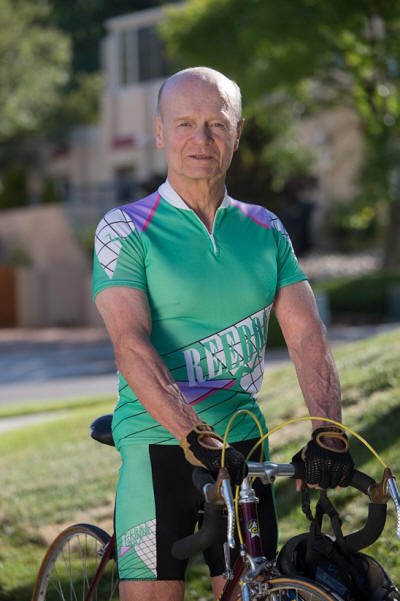
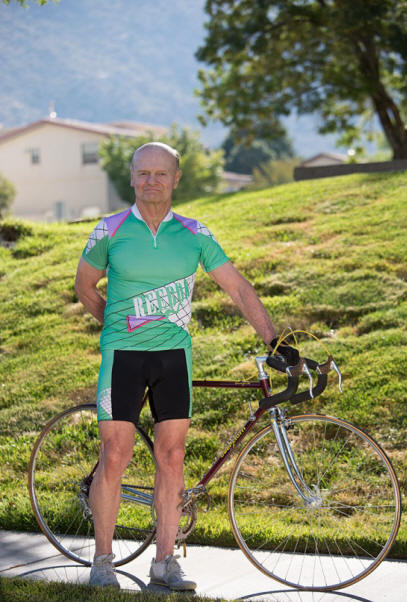
Laszlo took these photos of me in my biking days.
Harvard Health Letter (June 2024) awakened my interest with a piece on electric bikes. Doesn't make me want to buy one, but it is interesting and will be helpful to those who own an electric bike or may be thinking about buying one.
The Letter opens by telling us that annual sales of electric bikes has quadrupled between 2018 and 2022--and is still climbing. E-bikes sales are hot, making it important that people know what they are getting--and the risks involved.
How do they work?
E-bikes look like a regular bike, but have a built in motor powered by a lithium battery.
When the motor is off they function like a regular bike. When the motor kicks on--which can occur when you reach a certain speed or when you flip a switch--pedaling becomes easier. It puts less compression on your joints than a conventional bike, so it takes less effort to go at any given speed.
Even though your workout is less intense, you can ride longer and still get the exercise benefits. "Riding an e-bike might be a way to keep you in the saddle long after you thought your pedaling days might be behind you," Harvard adds encouragingly.
E-bike speeds:
The speed of your bike depends on its class. Class 1 is the lowest class and works only as you pedal and won't help once you reach 20 mph. The highest class (class 3) works the same way, but the motor will boost you up to 28 mph.
* * *
Harvard Health warns that zipping around at 20 mph or more can be risky if you haven't ridden a bike since you were a kid. "If you aren't used to riding at 10 or 12 mph--which is probably the speed you'd use for cruising around your neighborhood--you won't be able to handle it at 20 mph, and you probably won't have the skills to stop, turn, or navigate around something quickly," says a physical therapist with the Cycling Medicine Program at Harvard-affiliated Spaulding Rehabilitation Network.
"That's often when accidents happen."
That sounds like good advice. Be careful; take your time getting used to riding your motorized bike.
Carol and I see men and women on bikes flying down Tramway, the busy street below our home. I used to do the same thing, but I sure wouldn't do that now--without taking the time to get used to riding my bike again. AND I sure would take my time breaking in a new electric bike.
So, be careful and take your time getting used to your new electric bike.
You may be adding years to your biking days.
June 1, 2024
Multi-Vitamins?
Q: Are multi-vitamins worthwhile?
Based on this study, Dr. Komaroff believes it is likely that a daily multi-vitamin pill slows age-related cognitive decline, at least for two years, in people ages 60 and over.
He, however, cautions that many important questions remain unanswered.
"Would this benefit persist if people took multi-vitamins for more than two years? Do daily multi-vitamins also reduce the risk that a person will develop dementia? How do multi-vitamins produce their effects?
"These questions can only be answered by research."
Got it, but it's more than enough to make me continue taking my daily multi-vitamin.
May 1, 2024

Artificial Intelligence?
A: Artificial Intelligence - a branch of computer science that simulates human intelligence - is in the news these days.
It has its pluses and negatives.
The most obvious positive is that it can analyze large amounts of data and provide insights that can help humans make better decisions, such as in business, health care, or education.
On the downside it can displace human workers and cause unemployment.
There are many more angles, but that's a good beginning.
* * *
Carol found that AI profiled Clarence in the world of fitness:
Clarence Bass is an American writer, fitness expert, and retired lawyer who is best known for his book and DVD series Ripped, which chronicles his fitness journey and achievements, including becoming a Past-40 bodybuilding champion.
He was also a columnist for Muscle & Fitness magazine for 16 years, where he shared his advice and insights on combining weights, aerobics, and sound nutrition to achieve lifetime fitness and leanness.
He has written 10 books and produced three DVDs on
various aspects of fitness, health, and motivation.
He has been named “one of America’s greatest fitness visionaries” by Men’s Health magazine.
He is also a former Olympic-style weightlifter and a New Mexico Sports Hall of Fame inductee.
He has maintained a low body fat percentage and high level of fitness throughout his life, even into his 80s.
He is a pescatarian and lives in Albuquerque New Mexico with his wife Carol.
No complaints. We are pleased with AI's view of Clarence's achievements in the world of fitness.
(They got one thing wrong, however. Clarence was inducted into the Albuquerque High School Sports Hall of Fame, but has yet to be inducted into the New Mexico Sports Hall of Fame, although he has been nominated several times.)
* * *
While I am clearly no authority on AI, I would be leery of anything which is unsupported or dubious. It would be hard to argue with a computer or machine.
There are bound to be many more issues, but we are newbies and have a lot to learn.
That said, it was interesting to see how AI detailed Clarence's lifetime of achievements in the world of fitness. We are pleased and impressed.
March 1, 2024
Can Aging Be Reversed?
A: The August 2023 issue of the Harvard Health Letter tells us that injecting the blood of an old mouse into that of a young mouse caused the young mouse to age dramatically. On the other hand, injecting the blood of a young mouse into an old mouse caused the old mouse to become biologically younger. In short, the aging process can be accelerated and then reversed.
The Letter was quick to add that the study "did not identify the factors that cause or reverse aging, and that we are still a long way from being able to slow human aging more powerfully than a healthy lifestyle. But this kind of research offers hope that someday we will understand the aging process well enough to slow it."
Further research brought us to a piece by Andrew Zaleski in the January Bloomberg Businessweek about similar testing of "Biological Age."
It's the human version of the mouse study. A multi-millionaire spends a couple of million dollars to make his 45-year-old self function like a man less than half his age. "He has the heart of a 37-year-old, the skin of a 28-year-old, and the lung capacity and fitness of an 18-year-old," Bloomberg tells us.
His regimen consists of supplements, exact control of calories, and other methods including, until recently, swapping plasma with his 17-year-old son.
(As the New York Post put it, "Tech tycoon who spends $2 million per year to retain youth uses teen son as 'blood boy.''')
The end result for the average person, says Zaleski, comes down to four elements: "exercise, nutrition, sleep, and social connectivity."
Targeting those four elements can bring about a major advance on living a long and healthy life.
So, we don't need a "blood boy." We can "slow" the aging process with healthy living.
* * *
A long-time friend alerted us to a book by Peter Attia, MD titled OUTLIVE: The Science & Art Of Longevity (2023).
It's an owner's manual on living a long and healthy life.
Carol found it in the library down the street from our home and brought it home for a brief review. We also found positive reviews on Amazon.
We were sold! We bought the book.
* * *
Dr. Attia fills almost 500 pages exploring factors such as cholesterol, exercise, and nutrition--finding that ignoring emotional health "could be the ultimate curse of all."
He concludes that "you can plot a different path for your life, one that lets you outlive your expectations to make each decade better than the one before."
* * *
I decided to begin by focusing on Chapter 9: CHASING MEMORY. (As you will recall, my short term memory isn't what it used to be.)
His strategy for preventing Alzheimer's and other forms of mental decline is based on the following principles:
1: What's Good For The Heart Is Good For The Brain.
2: What's Good For the Liver Is Good For The Brain. (Metabolic health is crucial to brain health.)
3: Time Is Key. (Dr. Attia finds that we need to think about prevention early, and the more the deck is stacked against you genetically, the harder you need to work on staying healthy.)
4: Our Most Powerful Tool For Preventing Cognitive Decline Is Exercise. (Dr. Attia says exercise--lots of it--is the foundation for his Alzheimer's prevention program.)
Bob Hoffman convinced me as a teenager that exercise is the cure for just about everything. Turns out that he was more right than wrong.
* * *
To learn more, we suggest starting with the detailed reviews on Amazon, and then moving on to Dr. Attia's well written and thoughtful book. I suggest moving around in the book, rather than starting with page one. (If you're like me 500 pages is a bummer.)
Doctors should find the book helpful in explaining to patients that they can lengthen their health span. That they can do more to help themselves than any one can do for them.
* * *
Dr. Attia builds much of his book around a 40-year-old lady. The early death of her mother is putting her into a downward spiral.
These photos of me at 60 would help her realize that 60 can be young.


September 1, 2023
Comment on this article: FEEDBACK
Ripped Enterprises, P.O. Box 51236, Albuquerque, New Mexico 87181-1236
or
street address: 528 Chama, N.E., Albuquerque, New Mexico 87108,
Phone (505)
266-5858 , e-mail: cncbass@aol.com ,
Office hours: Monday-Friday, 8-5, Mountain time
Home | Products Index | Ripped Bks | Lean Adv. Bks | Lean For Life | Recommended Bks | |Consultations | Tapes | To Order | Feedback]
Copyright © 2024 Clarence and Carol Bass. All rights reserved.